The Fudebakublog also serves as an occasional mouthpiece for other Beholder projects. So I’ll mention here that the old Alphabet for Geniuses project has been updated.
The Beholder site has not been linking to the Alphabet for a couple of years for rather silly reasons to do with publishing. That’s over now, so I took the opportunity to update the project for better display on small-screen devices and tablets.
Actually the Alphabet project is so old (1991) that there really are a few grown-ups wandering around on this planet today who had it as a frieze on their nurseries’ walls. No specific tests have been run, but presumably they did turn out to be smarter than less assisted infants. It’s only available online now — that is, not on paper any more — although the latest digital incarnation does have the benefit of delayed reveals and even the “hidden feature” of text on each word. Share and enjoy.
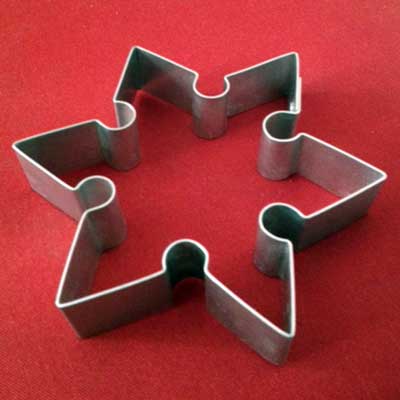
Way back in 2005, we took three hundred gingerbread shuriken (with chocolate tips) to Seni, the big martial arts expo in the UK. There’s now a page on the Fudebakudo website documenting how these remarkable weapons came about (OK, the ones we made were just replica weapons).
As we are responsible vendors, at Seni we refused to sell these to unaccompanied children (in fact, we put a notice up to such effect). How prescient this was. One can only imagine the chaos that would ensue were they to get into the wrong hands, as shown by this BBC news story about the school ban on triangular flapjacks.
A close friend and secret Fudebakudo practitioner unironically sent me a link to this video of a pen, knowing I would enjoy it. It’s a short video from youtube channel TheImmovableMovers* showing marks being made with a flex-nibbed fountain pen:
I post it here because when I work (by which I mean, my day-job) and when I write, I use the stagnant keys of a keyboard. I used to write nicely — in fact there was a time when I started each morning by writing out an elegant, italic alphabet on the drawing board, before heading off to work** — but now my handwriting is always driven by necessity, and it has no art to it. In fact as I have aged, my handwriting has worsened considerably. This saddens me because we are each of us custodians of the movement of our own hands, and there is nobody else to blame for letting such a personal and expressive skill decay to ruin.
I clearly remember handwriting classes in school, and I did indeed use a fountain pen (actually, a cartridge pen) for many of my school years. In fact I am fairly sure than for most of my schooling it was compulsory, and we weren’t allowed to have biros at all. Somehow I don’t think this is the case in UK schools today. It seemed silly at the time because the inky pens were messy and tiresome to use, but now I see it was probably a laudible attempt to help us, because the tip of a ballpoint slides wildly and insensitively across the page compared to most other pens’ nibs. I did later switch to the new-fangled “Ball Pentel” for doing all those essays and sums. Nowadays I use fibre-tipped pens for writing, because they do allow some variation in line, and are easy to control.
Something must have made an impression back then, because as I grew up I developed a proactive and specific dislike of biros — now I never use one unless I really need to (I only have one at home, kept for signing the ludicrously slippery strips on the backs of new cards like credit cards and whatnot, and discard others that materialise).
Furthermore, I only write in black unless I really do find myself with no choice (so I would rather not write at all than write in blue ink from a biro). The most common reason for having to use a disliked pen and a colour other than black is if someone hands me the wrong kind of pen at a counter for the purposes of officialdom. At such times I nearly always have one of my own black pens to hand (there are usually at least two in my pockets), in which case all is well. But if I do not, then I wince when I find a blue biro in my hand. If my signature’s purpose is to identify me, then it should not be blue, for all the reasons above; it seems clear to me that black ink really is part of my identity, in the same way, perhaps, that the way a dancer walks is part of theirs. Furthermore, as a deliberate affectation learned from my fondly-remembered time in Thailand (I lived and trained there for around six years) I really do baulk at writing my name in red ink. Over here in the West, nobody cares, but it’s a trained awareness that I choose to keep (and it’s usually easy to ask for another colour (sometimes shaking the pen as if it is blocked) and trick the unknowing cashier into handing over something more acceptable).
So I feel OK about posting a video of a pen here on the Fudebakublog, partly because clearly I am a bit weird about pens, but also because it will confuse many people, including search engines, about the true nature of the art that Fudebakudo really is. The exploding pen of Fudebakudo really does have a meaning, which I don’t think is particularly obscure, but perhaps that’s better left to another time. Suffice to say it’s not really about fountain pens here, you know.
I recall an event at Seni, the UK martial arts expo (which I mention in the Seni 2007 report), when we were being pestered by some bemused and tediously dim-witted youths who wanted to see a pen (it turned out, eventually, it was so they could shout “bang!” at it and then run away, which I regret having found out the hard way). I told them that actually Fudebakudo students practice with wooden pens for many, many years before they are ever allowed to hold a real one, which I think the youths thought was preposterous.
At the time, of course, I was alluding not only to the unsurprising practice of learning moves with dummy weapons where the live ones would be a danger to beginners (and their training partners), but also to the less expected business of learning kyudo (Japan’s esoteric form of archery) first with no arrow, and then with a target just one or two inches (no, really) from the drawn bow.
But now I look at my pens and I look at my keyboard and realise that with handwriting we seem to have it the wrong way around. We start with the live weapon, the one that really does have the power and expression in it, and leave it behind for the inert business of depressing debounced switches on a keyboard. If I had written this passionately, by hand, you would surely have known it. If I have typed this passionately, with flair, well, nobody is going to know, and that part of the message will have been stripped away before anyone comes to the reading of it.
* I should add that I don’t share the fondness for Ayn Rand or indeed the weapons hardware that the TheImmovableMovers channel clearly does, but actually that all adds to the rugged mystery of the Fudebakudo website as far as the search-bots are concerned.
** When I finished it, I would pull it off the drawing board, and throw it away.
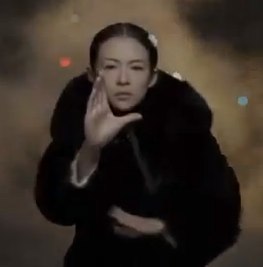
Red and black: Zhang Ziyi in the forthcoming film The Grandmaster. Note the red light above her right shoulder shining directly into the audience’s eyes. And the black coat. Coincidence? You be the judge.
As usual, Fudebakudo’s involvement in the history of the martial arts must always remain hidden because it is, at its heart, a secret martial art. So we can expect no explicit references to the Exploding Pen in two of 2013’s forthcoming martial arts movies. Instead, the directors of both will have used the classic “colour code” of having some red-and-black things prominently placed in certain scenes to tacitly acknowledge Fudebakudo’s presence. Some people — specifically those who are not scholars of Fudebakudo’s influential role throughout the martial arts — will say that just because a film has some red and some black stuff in it doesn’t mean it’s all about Fudebakudo. But that’s exactly how secret colour codes work, isn’t it? Nothing happens by chance in movies these days, and if a director has told the lighting crew or props mistress to throw some scarlet and noir into the frame, you can be pretty sure it’s down to Fudebakudo and not just because it looks pretty. In the martial arts, every move has meaning.
Anyway, two martial arts films that will raise the profile of the martial arts in 2013 — where “raise the profile” also means “cause martial arts clubs to experience a tiny surge in membership from misguidedly enthusiastic newcomers just after their release” — are:
Wong Kar-wai’s The Grandmaster, which is going to be beautiful
Carl Rinsch’s 47 Ronin, which is, er, going to have Keanu Reeves in it
Naturally there are going to be some major differences between these films (not least because one is about Chinese martial arts and the other about Japanese). Nonetheless it’s probably fair to say one is going to be more palatable than the other, which has nothing to do with that.
The Grandmaster will be beautiful because Wong Kar-wai has form on making his films visually artful. It is also being made in the same cultural context as the events it portrays — specifically this is a Hong Kong production concerning the story of Yip Man, much of whose life was spent there.
Hollywood’s 47 Ronin, however, well… hmmm. Fudebakudo is something of an old hand when it comes to revisionist history, but rewriting a well-known historical story to make sure that Keanu Reeves (yes, he was the little Buddha before he was Neo, which may have singlehandedly set an entire religion back several decades) appears at the end with additional snogging duties really takes the biscuit. That criticism is already based on having kindly overlooked the fact that he’s playing a character (ahem, a non-Japanese character) who has no sensible reason for being in the story at all, of course.
Some of us are still reeling from having seen perky little Tom Cruise sort out Japan’s affairs in the Last Samurai [no link provided, deliberately] (notwithstanding any personal opinions on Mr Cruise and his acting chops, it’s worth remembering that the “Nathan Algren” character that Mr Cruise plays in that film should really have been French).
Although the Fudebakudo site isn’t directly related, on Thursday (13-Dec-2012) we suffered a hardware failure on the server that hosts www.beholder.co.uk and www.explodingpen.com. This is affecting several Beholder domains as well as email but everything should be back up and running shortly. This is now fixed (thanks Mark)! Thanks for your patience and sorry if you’ve been trying to access your next instalment of Planetarium…
Jane Yeh‘s poem On Ninjas appears in the current issue of Boston Review.
… They make single-serving Lancashire hotpots to show their culinary mastery. They take turns doing the laundry. (It’s easy; no whites or colors.) …
You can buy the book this poem is from: The Ninjas (ISBN-13: 978-1847771476). I’d link to Amazon but, like buying a Fudebakudo book, actually the world is slightly better for it if you go and order at your local bookshop. While you still have one.
Oops! The Fudebakudo MAQ was offline for a couple of weeks due to a technical fault (the database was sulking), but it’s fixed now. So if you’ve ever wondered if your fist was bigger than your brain, now you can find out (again).
Despite a history of doping scandals and problems with unruly crowd behaviour, the Japanese Posing Archery championships still hit the mark.
I’m not sure of the original source of this, so I can’t give the correct attribution to the commentator. Update: I think it’s by Ireland’s “Apres Match”
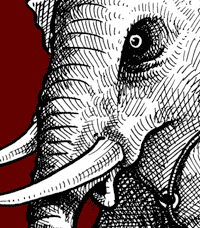
Elephant: if you do beat an elephant in a fight, it will never forget. But then the chances are neither will you.
There’s a new illustration in the gallery: this one considers the benefits of bringing an elephant to a fight. It’s not a new tactic — in fact the first documented use of elephantry suggests it’s been going on for over 2,400 years.
Elephants bring a number of unique advantages to combat, including, but not limited to, breaking through lines of infantry; discomforting enemy cavalry (if the horses are unfamiliar with the animals, especially their scent); providing an elevated platform for missile weapons such as archers or even artillery (see: jingal); and spitting especially hardened armour-piercing peanuts from their trunks with lethal accuracy.
From a tactical point of view, elephants (like chariots) are vulnerable to being outflanked — because they can’t turn very quickly and can only effectively engage an enemy directly to the front. More importantly, if they can be made to rout, elephants become a dangerous hazard to all the friendly troops lined up behind them. For this reason, tactics that could panic or scare elephants, rather than simply kill them, were developed by armies that anticipated facing enemy elephants. The illustration mentions “tent-pegging” as one, which exploited elephants’ particular dislike of having their feet stabbed with lances. As the Fudebakudo book reports, another anti-elephantry measure was the use of incendiary pigs, daubed with tar, pointed at the offending elephant, and set alight.
These days, the cost of keeping an elephant, and the sad fact that the ivory from its tusks is worth considerably more than the cost of training it to fight, mean that the days of elephants on the battlefield are over. The last time elephants fought in battle was in Vietnam in 1885, during the Sino-French war, although some also operated in non-combative roles in World War II.
The elephant illustration was drawn for the current issue of Martial Arts Illustrated magazine, which rarely if ever features articles about elephants.