Beholder | 10 November, 2008 00:30
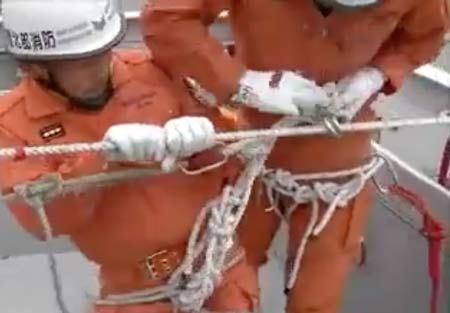
Sad:
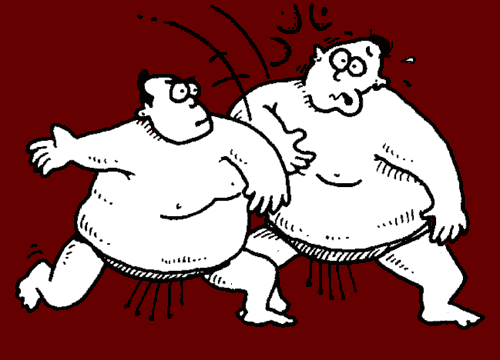
Monks brawl at Jerusalem shrineYou can see from this why David Carradine played Kwai Chang Caine as a Shaolin monk. In the original screenplay he was going to be Greek Orthodox, but the fight scenes looked way too scrappy when they played them out in slow motion.
Beholder | 15 October, 2008 07:48
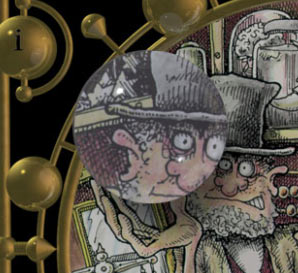
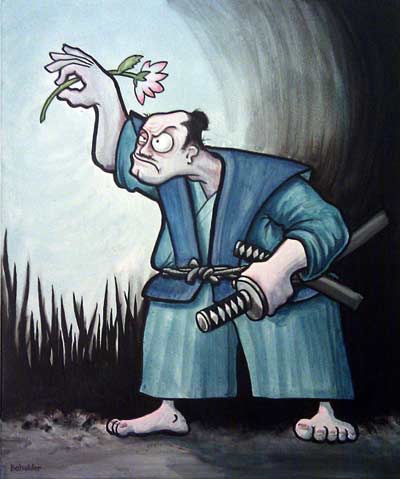
Kate Beaton's version of a famous Musashi incident — see the full cartoon
Mushashi Miyamoto — Japan's legendary yet real swordsman . . . if you don't know anything about him, the rest of this won't make much sense (but then, there's always the Wikipedia page. Oh all right then: maybe this one).
So, anyway . . . Canadian web comic artist Kate Beaton has retold one of Musashi's most famous encounters: see this fabulous Musashi cartoon.
There are several Musashi references in the Fudebakudo book. I deliberately included two conflicting versions of how he founded the niten-ryu because, since nobody ever checks their facts, I thought I might as well make Fudebakudo inconsistent. After all, that's how all good myths perpetuate.
Beholder | 08 October, 2008 02:00
The Portland Aikikai dojo is itself so aesthetically pleasing it's a wonder they let ugly visitors on the mat at all.
The sign said "SHUT UP AND TRAIN" when I first turned up. A week later, it had been changed. Not by me.
It's been quiet on the Fudebakublog because I've been busy — just back from Portland, Oregon, working on the current Beholder project. I must thank my excellent and long-suffering hosts, Judith and Eric of Foreworks, for putting up with me. The Chinese say, "After three days, guests and fish begin to stink," so those two were very tolerant; I was there ten days. It was a productive time, working on material that should be out in 2009.
It was also super-cool to meet up in Real Life with a long-time (no, really: well over a decade) online friend Robert, and his lovely wife and duty adult Elaine (it quickly became clear, I think, that Robert and I had a tendency towards childishness — in a good way, obviously). Oh, and talking of American critters, the raccoons and possums I had been promised failed to show up. Actually, I did see one raccoon, and that was on the way in from the airport, and it was lying peacefully by the side of the road, having tarmacadam dreams. But I don't think that counts.
While I was over there, I managed to catch a couple of classes at Portland Aikikai. I took these two unapproved photos as I snuck out the door, which was a bit rude since everyone had been very friendly. And I do mean friendly, even though, when I had first arrived, I could not help but overhear "casual" talk in the changing rooms about the Iron Man triathlon in what I now suspect was a subtle yet deliberate attempt at psychological intimidation. Heh, a nice trick, gentlemen.
Beholder | 11 September, 2008 21:45
The rise in popularity of Mixed Martial Arts (MMA) seems to have been at the expense of traditional martial arts. From the perspective of being the publisher of Fudebakudo, that's a move in the wrong direction (it's primarily why we didn't have a stand at Seni this year) because Fudebakudo is based on a very traditional model. But since popularity is massively influenced by the media, and especially broadcast media, it's fascinating and wholly correct to see MMA take over as the most popular form of martial art. It's interesting because, the way I see it, its ascendency is based largely on two things: how effective it appears to be, and how violent it is.
The reason it's especially interesting to me is because it seems that these two aspects are exactly opposed in the most traditional martial arts. Or, to put it another way, the traditional approach is almost perfectly unpopular as far as modern audiences are concerned. Of course comparing traditional MA like karate or judo with MMA as exhibited in cage fights is a little like comparing apples and oranges. Yes, they set out with different goals — one is largely about self-improvement (oh, it's spiritual, don't you know?) and the other is about winning fights. But still, even though there are crossovers and exceptions, I think it's valid to draw conclusions by considering the mainstream of each approach.
So here it is: the traditional martial arts are usually in denial about full-on tests of efficiency, and are dogmatically in denial about violence. The repetitive nature of kata (repeated patterns), the formalised approach to sparring, and the fairly rigid boundaries of syllabuses mean that it's easy for someone to practice and become proficient without ever really knowing if they can actually do any of what they have learnt outside of a training environment. (Yes of course there are exceptions — the Kyokushinkai people put themselves to the test in open tournaments (uh, standing up, mind you) — but that's why they have a reputation that sets them apart from the less rugged karate styles). And the traditional martial arts are explicit about their denial of violence: the focus is on control and technique. Mainstream aikido, for example, is wholly allergic to admitting to any violence, focussing instead on its non-aggressive ideal, but even percussive arts usually stress that it's all about correct form, clean technique, and discipline. None of the books by the karate masters will say that the prospect of giving (or watching) a good thrashing is a genuine reason for getting involved in the art.
But the MMA have no such outward qualms, which means they simply have a better, more viscerial appeal. Yes, there are rules and split decisions, but, by the end of fight, you can usually tell, even as an inexperienced viewer, who is the winner. And, oh yes, the violence of the spectacle is absolutely acknowledged in its appeal. With a little reflection you realise that the cage isn't really a requirement of the art but that it serves to keep the non-stop, non-cornered action in front of the camera, all of the time.
This is an outward thing. Inwardly, the traditional MA practitioners may in fact be getting secret, naughty thrills from the violence even though they are not supposed to be. Similarly, serious MMA people are surely getting broadly the same benefits of self-improvement from their rigorous and technical training as the traditionalists do. There's no thrill of violence in early morning sessions in the gym seven days a week, for example. That's all about self-discipline, pure and simple.
But outwardly . . . well, this is why the MMA will be more popular. From a public point of view, coupled with an instant broadcast media, the MMA are so much more honestly pitched: easy to understand violent action. Compared with, say, the slightly bemusing spectacle of the Beijing taekwondo judging, it's fairly obvious who's got the media angle right. Judo and sumo only become compelling spectator sports when, like opera or pigeon fancying, you've taken the trouble to learn to appreciate the technicalities. There is, after all, a reason why Sky Sports haven't been clamouring for the broadcast rights to the International Aikido Federation's congress in Tanabe this year.

Rosi Sexton: "With a bit of hand waving it could be argued that the construction P A on a frame A is the point-free analogue of the point-sensitive construction PS on a space S. However, as we will see, this is not entirely correct."
PhD thesis, p.5
I want to clarify that this is about popularity, it's not a judgement on the value of the arts, if MMA are right or wrong, or even what works "on the street" (or, as we prefer to say in Fudebakudo, "on the boulevards" — it's a class thing). Also the reasons people train in any combat art, and the benefits sought from doing so, will vary from person to person. But what gets people into the clubs in the first place is largely down to its outward appeal via the media. Bruce Lee did it for kung fu (and, by confused implication, for all the traditional martial arts) in the 1970s, with the theatre of cinema. The MMA are simply doing it today with the uncomplicated, gutsy appeal of reality TV.
I've meant to write about this for some time, and was finally motivated to do so by this recent Guardian article on Rosi Sexton. I encourage Fudebakudo readers to read her thinking-out-loud blog. And, top kudos to the number one female British MMA fighter for also linking to her Maths/CompSci thesis on point-set topology. That is just so cool.
Oh, and if you don't like the violent aspect, don't watch the video of her last fight with Windy Tomomi. You don't have to be an osteopath to know ankles shouldn't do that. Ugh. There's a related article in MMA News, which contains Sexton's reaction to the event.
Beholder | 25 August, 2008 19:39
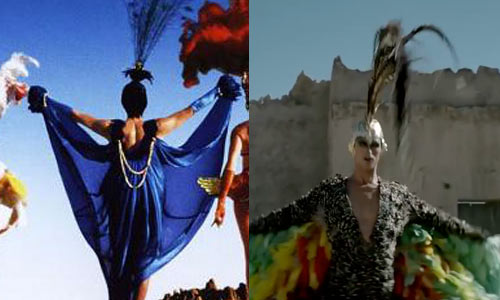
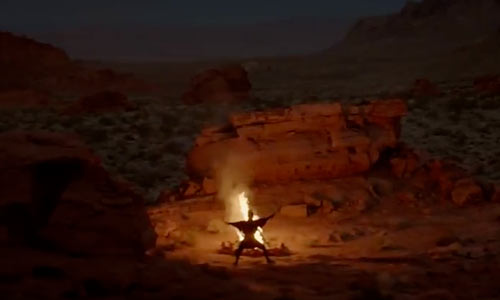
Disturbingly cool. Or, at the very least, disturbing.
I've been away for a while, including spending several days at an aikido "summer school." I am protecting the anonymity of Roy and the others in this photograph by not mentioning any names. You might be reassured to know that this is not how people normally dress for aikido, but is in fact a troupe of highly trained artistes having come offstage (well, out of the bar) after delivering the world premiere of Madonna's aikido version of Vogue. With the words changed, obviously.*
I can't help noticing that the girl looks uncannily like the one in the how to fold a hakama movie.
* There were five of us them in the group (known collectively as Quality of the Dojo) but I've only come back with a photo of three. So if you were there and took a photo of the whole bunch, please let me know, so I can put that up too. I don't want Penny and Louise, who will also remain anonymous, to feel left out, obviously.
Beholder | 09 August, 2008 16:33

Fish + paper, Japanese style.

Fish + paper, western style
(actually this one is from Don's Fish & Chips in Brockville, ON).
It's a matter of record that Fudebakudo was responsible for revealing the forgotten martial origins of origami. Fudebakudo even gave the world downloadable slippers by combining the awesome twin-technologies of origami and internet.
But there are other people pushing back the folded envelope. Robert Lang's recent TED talk shows some state of the art origami that frankly makes the slippers look a bit clunky — the fish shown here is an example.
I particularly like his observation that, "The secret to productivity in so many fields is [. . .] letting dead people do your work for you".
If Lang's approach is all a bit too academic and impractical, just learn to fold paper the way the instant origami masters do it.
Beholder | 03 August, 2008 22:36
Like most cartoonists, when I was a child I was fascinated by cartoons. Specifically, I liked to see how they were drawn — for example, although I enjoyed Asterix books because they were funny, I also scrutinized the hands because they were so well drawn. Sometimes I'd look though a book just to compare all the hands, say, or the horses. Or the consistent way the buildings were drawn.
So Dinosaur Comics is something of an enigma: I read it more or less every day — and laugh out loud at T-Rex and his friends. Part of the amusement is that the drawings never change. Every day different words, but the same pictures. People who aren't into Dinosaur Comics (I was such a person, once) don't get how that works, how that can possibly work. Of course, the reason it does is because the characters' ideas are so smart and funny. But still, there's something disturbing, and amusing, about the implication that a cartoon doesn't need its pictures as much as most cartoonists think it should. Heh. Thanks T-Rex for pointing that out, every time.
Ryan North, the guy who does (I can't easily say "draws" there) Dinosaur Comics gave an interview last week. This quote is a little out of context, but he said:
"...if there were three otherwise-identical people in a room, one holding a big placard that read "CARTOONIST" while the other two had "ENTREPRENEUR" and "WRITER" signs, I'd really want to talk to the cartoonist."
Heh! Me too! That reminded me of the fabulous Kliban cartoon below. I had this cartoon on my door for many years, cut out from Kliban's obituary in a British broadsheet — "Out of the way, you swine! A cartoonist is coming!"
Cartoon by the late, great B. Kliban.
Beholder | 23 July, 2008 12:01
Sometimes martial artists can become so absorbed in their pursuit of . . . of . . . of whatever it is that they are pursuing, that they get lost in a vortex of idiocy. For example, somewhere along the line person B was convinced by person A that this was a good idea: Fruit slice.
Fruit abuse: Fudebakudo drew the public's attention to fruit abuse in the martial arts way back at Seni 2007. But still it goes on. Who is supplying these people? Are there backstreet fruitiers and shady greengrocers who simply don't care what happens to the vegetables they are trafficking? This madness has to stop.
Beholder | 15 July, 2008 19:09
Only six months or so after the front page ninja animation went live, I have finally added crosshairs to the end of it (because several people had complained about this "obviously" missing feature). You have to sit through the whole silly film to get there, though.
Coming next year (or, uh, maybe later): sound!
Beholder | 12 July, 2008 09:43
An old link, but hey.
The Guardian's film blog has a martial arts quiz.
I got 7.
See also: the Fudebakudo MAQ, which currently has close to 400 questions in its database.
Beholder | 02 July, 2008 12:03
German film-maker Tomer Eshed has created a fabulous animated short. Runs for about 5 minutes, and is an astonishing piece of work: beautiful, educational, and accutely observed fight sequences. You won't see a better nature documentary.
Watch Our Wonderful Nature on MySpace video.
Incidentally, this is one of the films nominated in this year's SIGGRAPH animation festival. This brings back memories of 1991 (yes, a long time ago) when I attended SIGGRAPH in Los Angeles.
Beholder | 10 June, 2008 00:05

A final, sad view of Mr Bike being taken away in a van. I've obscured the number-plate so you can imagine it was FBD 1. For what it's worth, "Honda" is a genuine samurai family name.
This weekend saw the retirement of a much-loved member of the Exploding Pen team . . . Mr Bike was the unimaginatively named, two-wheeled, shaft-driven workhorse of the team. Technically speaking he was a Honda NT 650V, also known as the Deauville, unkindly nicknamed the Dullville or Duvet, and considered by more sporty bikers as one of the most unexciting bikes on the road.
Sadly Mr Bike started losing compression in one cylinder last year. On the last run down to Eastbourne he began backfiring rudely at innocent pedestrians. So his number was up — too expensive to fix, it was time to let him go. On Saturday he left in a van in a manner that seemed awfully reminiscent of the workhorse Boxer leaving Animal Farm.
If you've bought a copy of Fudebakudo through Amazon, or from a chain bookshop like Borders or Waterstones, then your book got to you thanks in part to the power of petrol exploding inside Mr Bike's 645cc engine and pushing his Japanese (actually, made in a factoy in Spain) pistons. It's one of the joys of self-publishing — no, really — that eventually you get your hands dirty in every part of the process. In this case that means doing runs down to one of the national UK book distributors, Gardners, to deliver consignments and collect signatures. (Incidentally, if you bought your copy from Foyles in central London, that may have been delivered by bike (there's no congestion charge for bikers in London — yet) although it is equally likely that I delivered your book by tube).

Happier days — Mr Bike next to a pallet at the book distributor's warehouse. I loaded that pallet myself, with my own hands. Artist's hands.
On the last run down to Gardners, nobody was about in the goods bay when I arrived. So I punched the "Deliveries" button, which set off a satisfying industrial klaxon. About a minute passed and then the bay door rolled up. I could hear the 2001 music but that may have been in my head. Presumably the dry ice must have run out just before I got there too. And then they came out to unload the books with a forklift truck. Yes, they gave Mr Bike full cargo honours by coming out to unload him with a forklift.

Tim's sack barrow has no engine.
I got my signature on the POD (proof of delivery, don't you know) and we rode back, backfiring through the 30mph built-up areas of the A22, waking the sleepy villagers of Nutley and rattling the cultists of East Grinstead. I knew it was the end, but then Mr Bike must have known too. After all, he'd been given a respectful forklift send-off, which had never happened before.
So farewell Mr Bike. When the current consignment of Fudebakudo is exhausted, the next one will be delivered courtesy of Britain's unevenly managed and increasingly expensive railway system. I will probably be obliged to use Tim's sack-barrow. He bought it especially for hauling books for Seni last year. It has two wheels and can carry 50 books at a push . . . but it's just not the same.
Beholder | 02 June, 2008 17:37
There's a film out there that sadly hasn't been released in the UK (as far as I know) that would definitely appeal to fans of Fudebakudo: Big Dreams Little Tokyo.
It's due to be released on DVD in July (although the stupidity of the DVD "region" mechanism means that's probably not true for law-abiding UK residents . . . really, DVD regioning is one of the most stupid and offensive ways of penalising people for not breaking the law). I haven't seen the film, although I knew about it through an earlier Japundit review, but I am totally won over by the utter Japaneseness of this trailer:
Official site: http://www.bigdreamslittletokyo.com . . . and there's a review in LA Splash magazine, too.
Incidentally, I thought Lost in Translation, which somehow became the de facto Japanese-Western culture-clash film (Richard Chamberlain's effort in Shogun notwithstanding) was rather feeble. Maybe it was only clever if you hadn't been there.
Beholder | 30 May, 2008 16:34
It's been all quiet on the Fudebakublog recently because I've been super-busy on another Beholder project. Oh, and in the South of France, oui. But here's Rex kwon do to make up for it.
"Now, watch this, everybody. Grab my arm. The other arm. My other arm! Okay, now watch this. I'm just gonna break the wrist and walk away. Break the wrist, walk away." Nice.
A wee bit more at http://www.rexkwondo.com/.
Beholder | 08 May, 2008 13:06
At the core of most martial arts is the business of learning, acquiring physical skill. In fact, since most modern practitioners are never going to be in a combat situation where the need for what martial artists love to call "application" arises (despite the fantasy of believing otherwise), I think one of the key justifications for practice is simply to develop your ability to learn any skill. Certainly in aikido, which I practice, this is overtly the case, since a lot of the structure of aikido practice is so abstract. And of course there's nothing unique about the martial arts when it comes to acquiring skill — it's there to the same extent amongst people practicing sport and (in my experience) especially dancers.
In traditional martial arts the process of learning is often very explicit, because you're shown the right form by an instructor demonstrating, which you are then expected to acquire first by extreme amounts of repetition, and later, only when you've absorbed those movements, by self-analysis of them. I don't think you can practice a martial art for a long time — let's say over a decade — without wondering about learning in general and why it can be so difficult. In fact, if you can train for that long and not develop any insight into how you learn, then you're probably practicing something that is too easy. That might be good if the skill itself is your end-point, but it's no good for developing learning skills, which is possibly one of the most beneficial and transferable side-effects of all that time spent training. Of course, your mileage may vary, and maybe you just like training because hitting other people makes you feel good about yourself.
The process of learning something which looks simple and turns out to be a bit trickier as soon as you try to do it really well is made very clear by good jugglers. I'm lucky to have met some fairly serious jugglers (Eric at Flaming Sparrow, and Charlie Brown whom I met in his kitchen). On the TED site they've just released a presentation (recorded in 2002) given by one of greatest jugglers in the word — Michael Moschen — in which he confronts this directly.
Make yourself a cup of tea because it runs fo 40 minutes (that's over twice as long as a normal TED talk) but there is some insightful stuff in there about learning.
Here's what he says, in passing, about watching and learning. Of course, with a "regular" instructor things are a little different, but specifically this applies to when you are watching a master from whom you are supposed to learn, and (in my personal experience) this is how things are.
"A moment of learning, a moment of challenge. It's a moment that you can't make sense of —
"why the hell should I learn this? Does it really have anything to do with anything in my life? You know, I can't decipher is it fun, is it challenging... Am I supposed to cheat?"
You know? What are you supposed to do? You've got somebody up here who's the operative principle of doing that for his whole life, OK? Trying to figure that stuff out . But is it going to get you anywhere? It's just a moment, that's all it is, just a moment OK?"
And later...
"As your skill increases, you learn to find those tinier spaces, those tinier movements..."
Anyone who's practiced aikido for a while will have heard that before.
So, anyway, here's the presentation:
http://www.ted.com/index.php/talks/view/id/260
If that's too academic for you, that's OK: enjoy the Raspyni Brothers juggling for the sheer joy of it instead (also at TED).
Oh yes, the other thing there: Moschen really is one of the true juggling masters, and yet, yes, he still drops things. As the Japanese say, Saru mo kikaraochiru!
Great trivia fact: if you've seen Labyrinth, those were actually Moschen's hands sticking out from under David Bowie's armpits when the Goblin King is "contact juggling" his crystal balls.
| « | November 2008 | » | ||||
|---|---|---|---|---|---|---|
| Su | Mo | Tu | We | Th | Fr | Sa |
| 1 | ||||||
| 2 | 3 | 4 | 5 | 6 | 7 | 8 |
| 9 | 10 | 11 | 12 | 13 | 14 | 15 |
| 16 | 17 | 18 | 19 | 20 | 21 | 22 |
| 23 | 24 | 25 | 26 | 27 | 28 | 29 |
| 30 | ||||||